
Restaking Protocols – The Future of Shared Security
Project Name: EigenLayer
Year Founded: 2021
Country / Origin Team: USA
Project Type: Infrastructure, Restaking
Website: https://www.eigenlayer.xyz/
Whitepaper: https://docs.eigenlayer.xyz/eigenlayer/overview/whitepaper
Founder: Sreeram Kannan
Social:
.png)
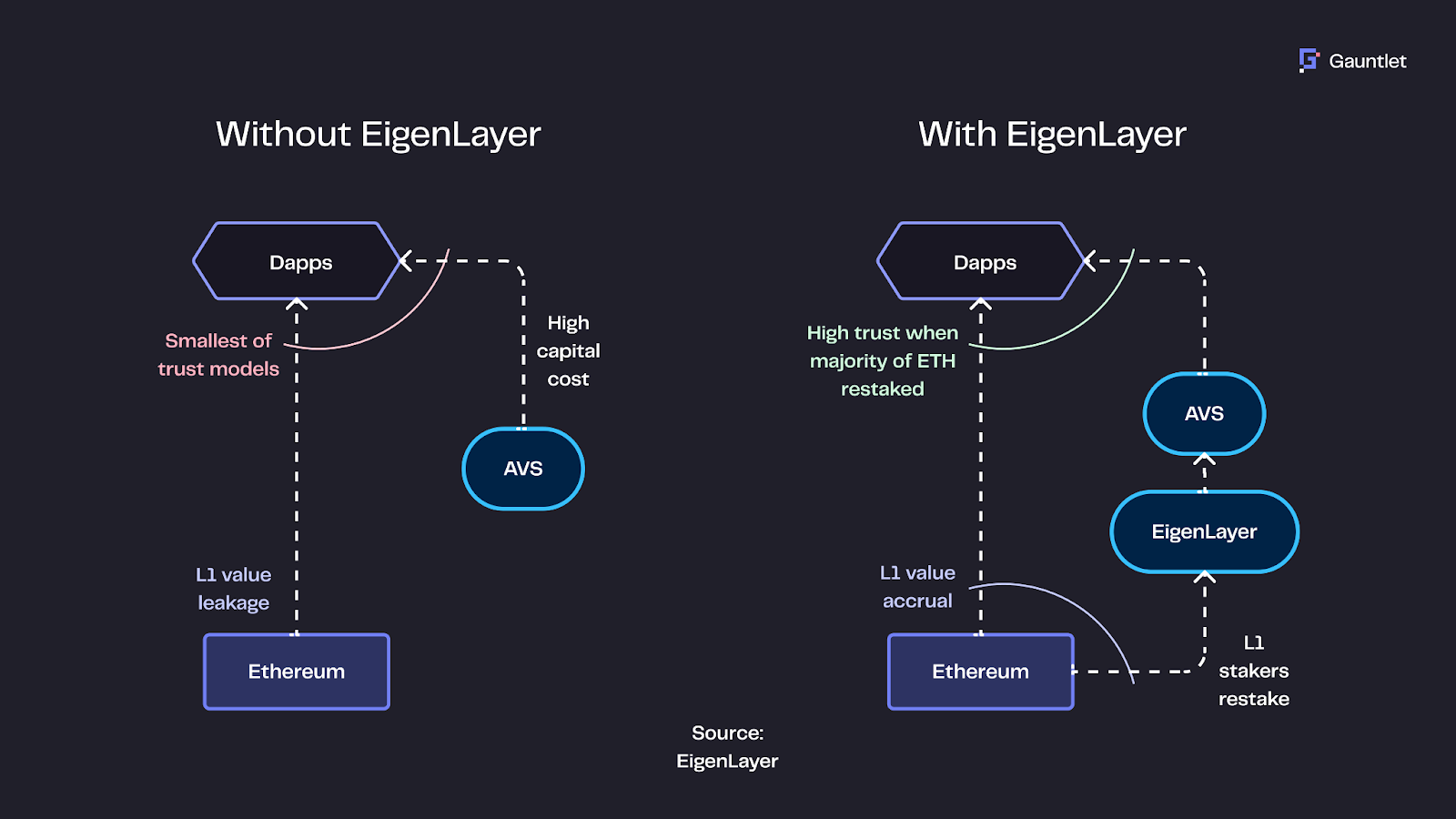
Restaking protocols are emerging as a pivotal innovation in the blockchain landscape, building upon the foundational security principles established by platforms like Ethereum. This concept allows users to leverage their already staked assets, typically ETH, to secure additional decentralized applications or services beyond the primary blockchain. This novel approach introduces a paradigm of shared security, offering new protocols the ability to access a robust and battle-tested economic security layer without needing to bootstrap their own validator set from scratch. It represents a significant step forward in optimizing capital efficiency and fostering a more interconnected and secure Web3 ecosystem.
At its core, restaking extends the trust and economic guarantees of a parent chain to various Actively Validated Services (AVSs), such as oracles, bridges, data availability layers, or decentralized sequencers. Stakers can opt to restake their assets, agreeing to additional slashing conditions in exchange for further rewards from these AVSs. This mechanism not only amplifies the utility of staked capital but also significantly lowers the barrier to entry for new decentralized applications. Instead of relying on nascent or smaller validator networks, these new services can inherit the vast security budget of a major proof-of-stake blockchain, creating a more robust and resilient foundation for their operations.
The benefits of restaking extend far beyond mere capital efficiency. By pooling security, it encourages greater interoperability and innovation across the decentralized landscape. New projects can launch with higher assurance against attacks, attracting users and developers who prioritize security. This shared security model reduces fragmentation and allows for a more efficient allocation of resources, accelerating the development of novel applications and infrastructure. It fosters an environment where diverse decentralized services can thrive, each benefiting from a collective security umbrella, paving the way for a more integrated and scalable Web3 future.

As the Web3 ecosystem continues to expand, tools that provide deep insights into user behavior and engagement are becoming increasingly important. For projects building new restaking protocols or AVSs leveraging restaking, understanding potential stakers, communities, and emerging trends is crucial for growth and adoption. This is where platforms like Web3Lead come into play.
Web3Lead is a powerful user-growth platform built specifically for Web3 and crypto projects. It gives you access to over 400 million social profiles and 1.2 million Web3/crypto communities, enabling deep insights into user behavior and trends. With its analytics tools, you can monitor and segment communities, identify high-potential users, and predict emerging trends. Their user-growth engine helps you acquire real users by providing contactable data like email, phone, and social profiles. Web3Lead supports data-driven growth strategies, helping Web3 projects scale efficiently and sustainably.
See more Web3 project reviews on Web3Lead

Developers and teams behind restaking protocols can leverage Web3Lead to identify key stakeholders, target potential stakers or delegators, and optimize their user acquisition strategies. By combining the technical innovation of restaking with growth-focused tools like Web3Lead, these projects can accelerate adoption and achieve sustainable engagement within the decentralized ecosystem. This synergy ensures that groundbreaking security mechanisms not only exist but also reach the right audience to flourish.
The future trajectory of restaking protocols promises to further decentralize and secure critical Web3 infrastructure. Imagine a world where every oracle, every cross-chain bridge, and every data availability layer is secured by a vast, economically robust network, making them virtually unassailable. This interconnected security paradigm can unlock entirely new categories of decentralized applications, from highly secure enterprise solutions to complex DeFi primitives that require ironclad assurances. The continuous evolution in how security is distributed and leveraged is reshaping the very architecture of Web3.
Moreover, restaking protocols are not isolated; they actively enhance interoperability and efficiency across different blockchain networks. By providing a common security layer, they facilitate seamless interactions between various chains and Layer 2 solutions, reducing the inherent risks associated with cross-chain communication. This integration elevates the potential for decentralized applications to achieve global reach and efficiency, further solidifying Web3’s promise of an open and permissionless future. The ability to abstract and pool security is a testament to the ingenuity driving the next wave of blockchain innovation, emphasizing that while infrastructure is critical, understanding and engaging with the community remains paramount for any project’s success.