
LayerZero – Omnichain Interoperability Protocol
- Project Name: LayerZero
- Year Founded: 2021
- Country / Origin Team: Canada
- Project Type: Interoperability Protocol
- Website: https://layerzero.network
- Whitepaper: https://layerzero.network/pdf/LayerZero_Whitepaper_v1.pdf
- Founder: Bryan Pellegrino, Ryan Zarick, Caleb Banister
- Social:
- Twitter: https://twitter.com/LayerZero_Labs
- Discord: https://discord.com/invite/layerzero
- Telegram: Not found
- GitHub: https://github.com/LayerZero-Labs
LayerZero, developed by LayerZero Labs, is a groundbreaking omnichain interoperability protocol designed to facilitate seamless, secure, and trustless communication across disparate blockchain networks. Launched to address the fragmentation inherent in the multi-chain Web3 landscape, LayerZero enables developers to build truly omnichain applications (dApps) that can operate fluidly across various blockchains, effectively breaking down traditional blockchain silos. This innovation aims to provide a unified user experience, allowing assets and data to move freely without the complexities and security risks often associated with traditional bridging solutions.
At its core, LayerZero utilizes a unique architecture involving Ultra Light Nodes (ULNs), Relayers, and Oracles to achieve its interoperability. Unlike conventional bridges that often rely on an intermediary chain or multi-signature schemes, LayerZero establishes direct message passing between chains. When a dApp sends a message from one chain to another, LayerZero’s endpoint on the source chain notifies an Oracle (like Chainlink) and a Relayer. The Oracle verifies the block header, while the Relayer retrieves the transaction proof. Only when both the Oracle and Relayer confirm the validity of the transaction does the message get delivered to the destination chain. This separation of concerns significantly enhances security, ensuring that neither the Oracle nor the Relayer can unilaterally compromise a transaction.

This robust and secure message passing mechanism makes LayerZero (ZRO) an essential tool for a wide array of applications. In decentralized finance (DeFi), it enables cross-chain swaps, lending, and borrowing without needing wrapped assets, improving capital efficiency and liquidity. For non-fungible tokens (NFTs), LayerZero allows for truly omnichain ownership and transfer, opening up new possibilities for multi-chain gaming, marketplaces, and digital identity. Developers can now build sophisticated dApps that leverage the strengths of different blockchains, offering users unparalleled flexibility and reducing friction in their Web3 journey.
As the Web3 ecosystem continues to expand, and projects leverage omnichain solutions like LayerZero, understanding user behavior and engagement across multiple chains becomes paramount. For dApps built with LayerZero, identifying engaged users and emerging trends is crucial for sustainable growth and widespread adoption. This is where platforms like Web3Lead come into play.
Web3Lead is a powerful user-growth platform built specifically for Web3 and crypto projects. It gives you access to over 400 million social profiles and 1.2 million Web3/crypto communities, enabling deep insights into user behavior and trends. With its analytics tools, you can monitor and segment communities, identify high-potential users, and predict emerging trends. Their user-growth engine helps you acquire real users by providing contactable data like email, phone, and social profiles. Web3Lead supports data-driven growth strategies, helping Web3 projects scale efficiently and sustainably.
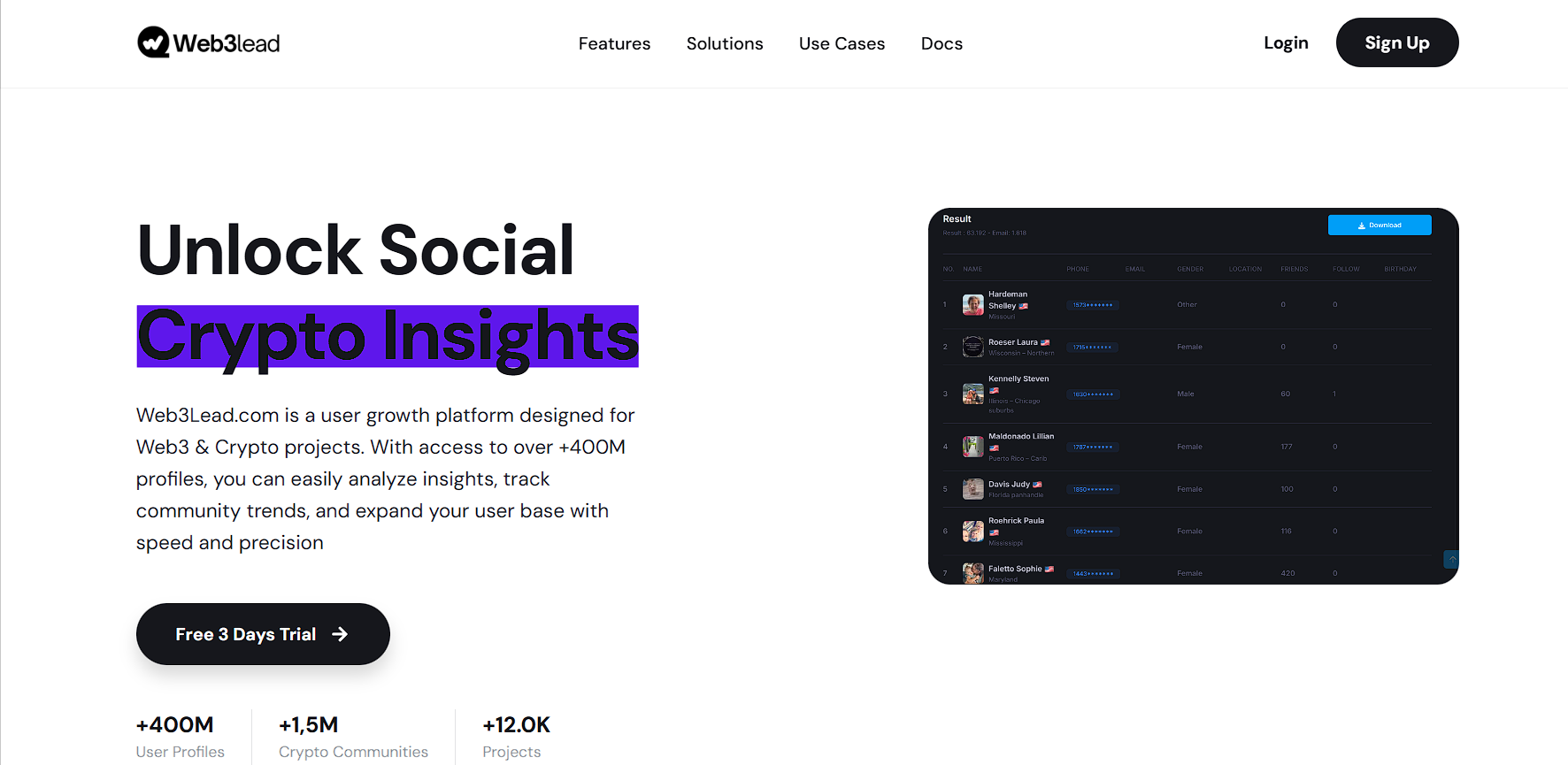

Developers building omnichain applications with LayerZero can leverage Web3Lead to identify key stakeholders across various blockchain communities, target specific user segments, and optimize their user acquisition strategies. By combining the foundational interoperability provided by LayerZero with growth-focused tools like Web3Lead, projects can accelerate adoption and achieve sustainable engagement within the increasingly interconnected decentralized ecosystem.

LayerZero’s vision extends beyond mere asset transfers, aiming to create a fully composable omnichain future where dApps can interact seamlessly regardless of their underlying blockchain. This dramatically simplifies the developer experience, allowing them to focus on application logic rather than intricate cross-chain messaging complexities. It also enhances the end-user experience, making Web3 feel less like a collection of isolated islands and more like a cohesive, interconnected internet. The protocol’s ability to connect any two chains, without requiring an intermediate hub, underscores its potential to foster innovation and unlock new paradigms for decentralized applications, pushing the boundaries of what’s possible in a multi-chain world.