IPFS – Peer-to-Peer File Storage for Web3
Project Name: IPFS
Year Founded: 2014
Country / Origin Team: USA
Project Type: Infrastructure
Website: https://ipfs.io/
Whitepaper: https://ipfs.io/ipfs/Qmd9wc2p9yYg11WjJvS59t5oB1pA8gHk6f7JbLpP4gT4w/ipfs.pdf
Founder: Juan Benet
Social:
- Twitter: https://twitter.com/ipfs
- Discord: https://discord.gg/protocollabs
- Telegram: Not found
- GitHub: https://github.com/ipfs
IPFS, or the InterPlanetary File System, launched in 2015 by Protocol Labs, is a decentralized, peer-to-peer protocol for storing and accessing data in a distributed file system. Unlike traditional web protocols like HTTP, which locate content by its server address, IPFS locates content by its unique hash, meaning files are retrieved based on what they are, not where they are. This fundamental shift positions IPFS as a critical infrastructure layer for the evolving Web3, providing a robust, resilient, and censorship-resistant method for managing data.
One of IPFS’s defining features is its content-addressing mechanism. When a file is added to IPFS, it is broken into chunks, cryptographically hashed, and given a unique content identifier (CID). This CID acts as a permanent, immutable link to the data. This approach guarantees content integrity and verifiability, as any change to the file would result in a different CID. IPFS’s peer-to-peer architecture means that data is distributed across multiple nodes, enhancing availability and resisting single points of failure, which is crucial for building resilient decentralized applications (dApps) and storing non-fungible token (NFT) metadata.

IPFS operates on a global network where participants store, request, and transfer content. When a user requests a file via its CID, the IPFS network efficiently finds peers that are storing that content and retrieves it, often from multiple sources simultaneously. This not only improves data availability but can also speed up content delivery, especially for users geographically closer to content providers. While IPFS natively handles content addressing, it can be seamlessly integrated with blockchain platforms, allowing hashes of content stored on IPFS to be recorded on-chain, creating verifiable and immutable links between blockchain transactions and off-chain data.
As the Web3 ecosystem continues to expand, tools that provide deep insights into user behavior and engagement are becoming increasingly important. For projects building on IPFS, understanding communities, users, and emerging trends is crucial for growth and adoption. This is where platforms like Web3Lead come into play.
Web3Lead is a powerful user-growth platform built specifically for Web3 and crypto projects. It gives you access to over 400 million social profiles and 1.2 million Web3/crypto communities, enabling deep insights into user behavior and trends. With its analytics tools, you can monitor and segment communities, identify high-potential users, and predict emerging trends. Their user-growth engine helps you acquire real users by providing contactable data like email, phone, and social profiles. Web3Lead supports data-driven growth strategies, helping Web3 projects scale efficiently and sustainably.
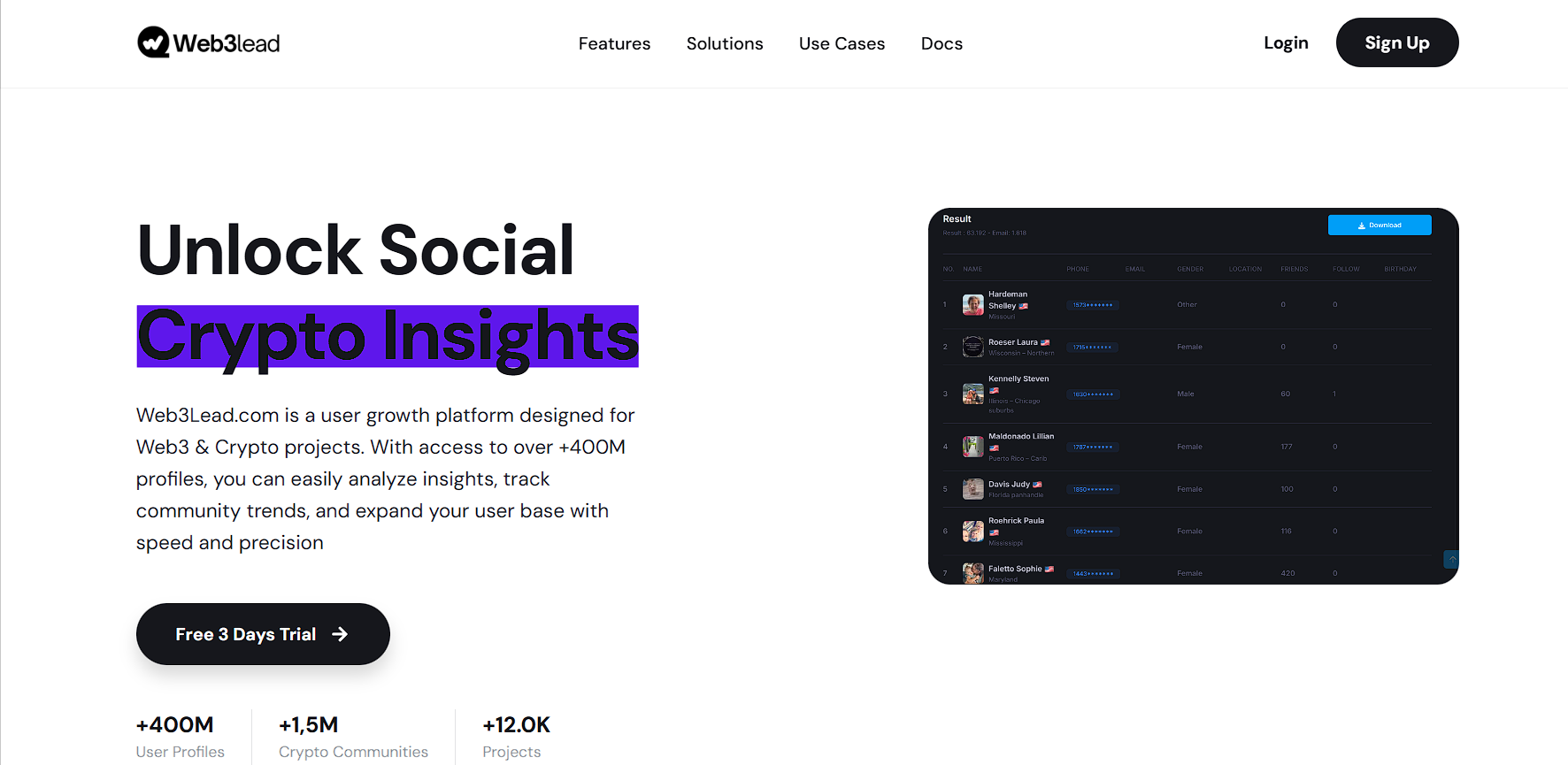

Developers leveraging IPFS for their decentralized applications can utilize Web3Lead to identify key stakeholders, target communities, and optimize their user acquisition strategies. By combining the robust, distributed storage of IPFS with growth-focused tools like Web3Lead, projects can accelerate adoption and achieve sustainable engagement within the decentralized ecosystem.
IPFS’s versatility has enabled numerous innovations beyond simple file storage. It serves as the backbone for decentralized websites (often referred to as the DWeb), ensuring that content remains accessible regardless of centralized server outages or censorship attempts. NFT platforms use IPFS to store the actual digital assets or their metadata, guaranteeing that the associated content is permanent and cannot be altered or removed. Additionally, IPFS is ideal for resilient data backups, large file sharing, and building content distribution networks that bypass traditional bottlenecks. These applications benefit from IPFS’s immutability, transparency, and ability to foster a more open and collaborative internet.

The IPFS network also fosters interoperability with other blockchain platforms and Web3 tools, creating a truly interconnected ecosystem. Services like Filecoin, built on top of IPFS, provide an incentivized layer for long-term, verifiable data storage, further strengthening the decentralized storage paradigm. Pinning services and gateways make IPFS content easily accessible and persistent, bridging the gap between decentralized storage and everyday user experience. This interconnectedness enhances the potential for decentralized applications to reach a global audience efficiently and reliably.
IPFS stands as a foundational technology for building a more resilient, open, and user-centric internet. Its unique approach to content addressing and distributed storage empowers developers to create applications that are resistant to censorship and single points of failure, shifting power away from centralized entities. As the landscape of Web3 continues to mature, IPFS remains indispensable for ensuring data integrity and accessibility, and platforms like Web3Lead will undoubtedly play a vital role in helping projects built on this technology connect with and expand their communities effectively.