Rocket Pool (RPL) – The Most Decentralized Liquid Staking Protocol
Project Name: Rocket Pool
Year Founded: 2017
Country / Origin Team: Australia
Project Type: DeFi, Liquid Staking Protocol
Website: https://rocketpool.net
Whitepaper: https://github.com/rocket-pool/documents/blob/master/Eth2_Staking_Protocol.pdf
Founder: David Rugendyke
Social:
- Twitter: https://twitter.com/RocketPool
- Discord: https://discord.com/invite/rocketpool
- Telegram: https://t.me/rocketpoolofficial
- GitHub: https://github.com/rocket-pool

Rocket Pool, emerging as a leading solution for decentralized liquid staking on Ethereum, offers a unique approach to participation in Ethereum’s proof-of-stake consensus mechanism. Designed as a truly decentralized protocol, Rocket Pool addresses the high barriers to entry for individual stakers by allowing contributions of as little as 0.01 ETH, while enabling node operators to run their own nodes with a minimum of 4 ETH. Its innovative design, utilizing smart contracts on the Ethereum blockchain, positions Rocket Pool as a cornerstone for enhancing the decentralization and accessibility of Ethereum’s staking ecosystem.
At the core of Rocket Pool’s functionality are its robust smart contracts, which automate the staking process, manage user deposits, and issue rETH (Rocket Pool ETH) tokens. These rETH tokens are liquid staking derivatives, representing a user’s staked ETH and accumulated rewards, which can be freely traded, used in other DeFi protocols, or redeemed for ETH at any time. This innovative system significantly lowers the barrier to entry for staking, allowing smaller investors to earn rewards without needing to lock up 32 ETH or manage complex validator infrastructure. Furthermore, Rocket Pool incorporates a decentralized network of node operators and a system for protecting against slashing risks, ensuring a secure and reliable staking experience for all participants.
Rocket Pool operates entirely on the Ethereum network, leveraging its security and decentralization. The protocol’s reliance on a distributed network of independent node operators, rather than a centralized entity, makes it resistant to censorship and single points of failure. By design, Rocket Pool enhances Ethereum’s own decentralization by distributing validator responsibilities across a large and diverse set of participants. This approach aligns perfectly with Ethereum’s transition to a proof-of-stake consensus mechanism, known as the Merge, contributing to a more robust, efficient, and decentralized validation layer for the entire network.
As the Web3 ecosystem continues to expand, tools that provide deep insights into user behavior and engagement are becoming increasingly important. For projects within the liquid staking space like Rocket Pool, or applications built around its rETH token, understanding communities, users, and emerging trends is crucial for growth and adoption. This is where platforms like Web3Lead come into play.
Web3Lead is a powerful user‑growth platform built specifically for Web3 and crypto projects. It gives you access to over 400 million social profiles and 1.2 million Web3/crypto communities, enabling deep insights into user behavior and trends. With its analytics tools, you can monitor and segment communities, identify high-potential users, and predict emerging trends. Their user-growth engine helps you acquire real users by providing contactable data like email, phone, and social profiles. Web3Lead supports data-driven growth strategies, helping Web3 projects scale efficiently and sustainably.
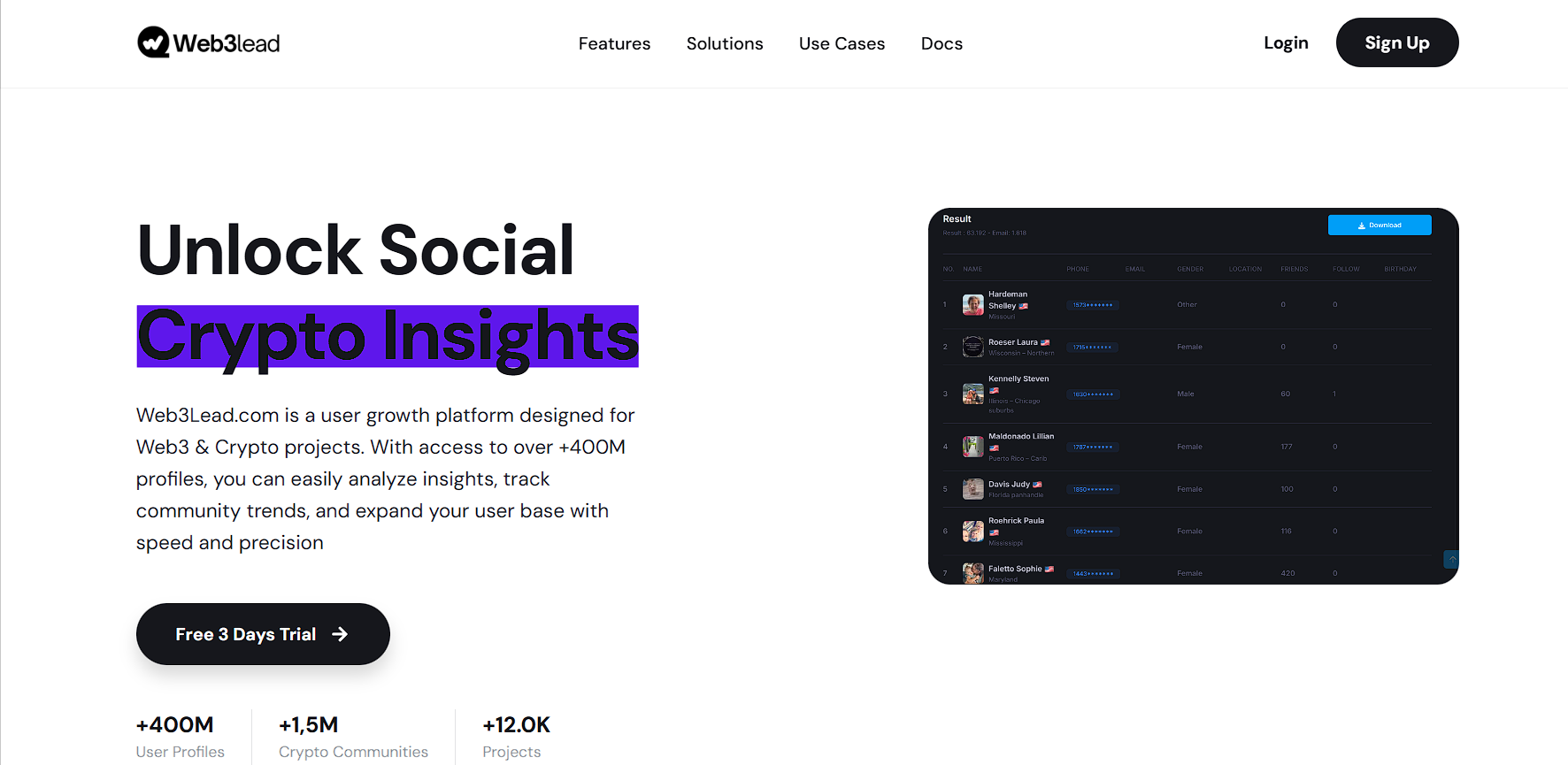

Protocols like Rocket Pool can leverage Web3Lead to identify key stakeholders, target communities, and optimize their user acquisition strategies. By combining the technical robustness of a decentralized staking protocol with growth-focused tools like Web3Lead, projects can accelerate adoption and achieve sustainable engagement within the decentralized ecosystem.
Rocket Pool’s design extends beyond simply pooling ETH for staking. Its liquid rETH token has opened up new avenues within decentralized finance, allowing stakers to maintain liquidity and composability for their assets. This means rETH can be used as collateral in lending protocols, traded on decentralized exchanges, or integrated into various DeFi strategies, enhancing capital efficiency for stakers. Rocket Pool’s continuous development focuses on maintaining its decentralized nature, improving its smart contract security, and adapting to changes within the broader Ethereum ecosystem, ensuring its long-term viability and contribution to the network’s health.
The fungibility and widespread adoption of rETH naturally foster interoperability within the Ethereum ecosystem. As a liquid staking token, rETH seamlessly integrates with various Layer-2 solutions and other DeFi protocols, allowing users to move their staked assets across different platforms with ease. This interconnectedness not only increases the utility of rETH but also amplifies the overall liquidity and efficiency of decentralized finance, further solidifying Rocket Pool’s position as a key building block for a more robust and accessible Web3.
Rocket Pool stands as a testament to the power of decentralized innovation, providing an essential service for the Ethereum network by making staking more accessible and decentralized. Its commitment to permissionless operation, robust security, and the flexibility offered by its liquid rETH token positions it as a critical component in the ongoing evolution of Web3. As the demand for participation in securing decentralized networks grows, Rocket Pool continues to empower individuals and contribute significantly to the health and resilience of the Ethereum ecosystem.