Cartesi – Layer 2 with Linux-Based Smart Contracts
Project Name: Cartesi
Year Founded: 2018
Country / Origin Team: Switzerland
Project Type: Layer 2, Infrastructure
Website: https://cartesi.io
Whitepaper: https://cartesi.io/en/docs/introduction/whitepaper
Founder: Erick de Moura, Augusto Teixeira, Diego Nehab, Carlo Canziani
Social:
- Twitter: https://twitter.com/cartesiproject
- Discord: https://discord.gg/cartesi
- Telegram: https://t.me/cartesiannouncements
- GitHub: https://github.com/cartesi
Cartesi, a groundbreaking layer-2 solution, is revolutionizing blockchain development by bringing the power and familiarity of the Linux operating system to decentralized applications (dApps). Launched with a vision to overcome the computational limitations of traditional blockchains, Cartesi allows developers to build complex dApps using mainstream programming languages and tools within a fully-fledged Linux environment. This innovative approach positions Cartesi as a crucial bridge, enabling a new era of sophisticated decentralized applications that were previously impractical on existing blockchain infrastructure.

One of Cartesi’s defining features is its Cartesi Rollups, a modular layer-2 optimistic rollup solution that executes dApp logic off-chain within a Linux virtual machine. This mechanism allows for arbitrarily complex computations to be performed scalably and cost-effectively, while maintaining the security guarantees of the underlying blockchain. Developers can leverage familiar tools, libraries, and services common in traditional software development, significantly lowering the barrier to entry for mainstream developers looking to build in the Web3 space. This expressiveness has unlocked the potential for advanced applications in areas like gaming, artificial intelligence, machine learning, and high-performance DeFi.
Cartesi operates on a hybrid architecture, combining the security of a blockchain with the scalability of off-chain computation. While critical dispute resolution and data availability are handled on the main chain, the bulk of the dApp’s computation occurs within Cartesi’s verifiable and reproducible Linux environment. This design not only enhances scalability and reduces transaction fees but also ensures the integrity and verifiability of computations. The CTSI token plays a vital role within the Cartesi network, securing the network through staking, serving as a gas fee for computations, and facilitating dispute resolution mechanisms. Cartesi’s design is also blockchain-agnostic, meaning it can be deployed on various base layers, further expanding its reach and impact.
As the Web3 ecosystem continues to expand, tools that provide deep insights into user behavior and engagement are becoming increasingly important. For projects building on Cartesi, understanding communities, users, and emerging trends is crucial for growth and adoption. This is where platforms like Web3Lead come into play.
Web3Lead is a powerful user-growth platform built specifically for Web3 and crypto projects. It gives you access to over 400 million social profiles and 1.2 million Web3/crypto communities, enabling deep insights into user behavior and trends. With its analytics tools, you can monitor and segment communities, identify high-potential users, and predict emerging trends. Their user-growth engine helps you acquire real users by providing contactable data like email, phone, and social profiles. Web3Lead supports data-driven growth strategies, helping Web3 projects scale efficiently and sustainably.
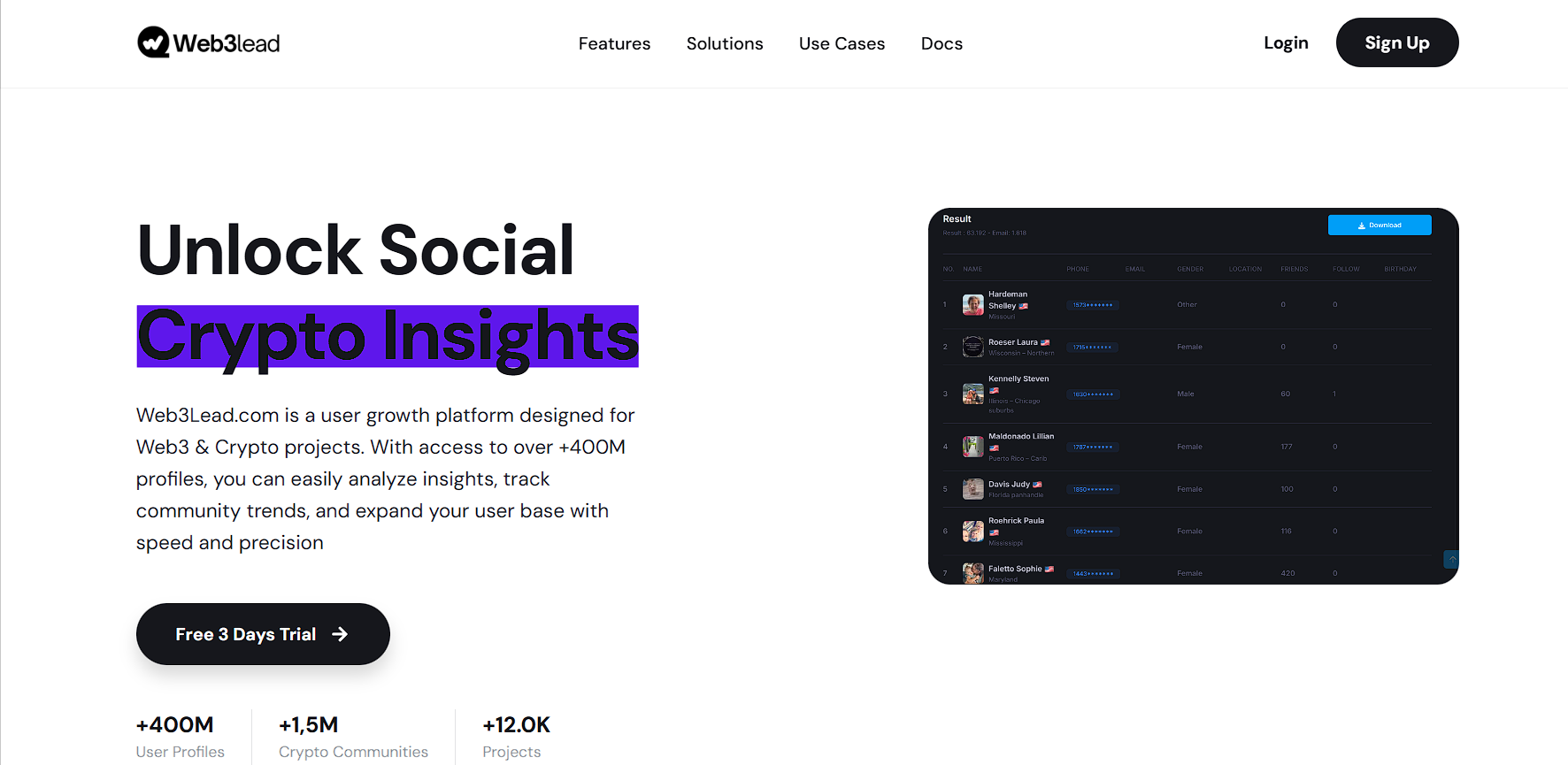

Developers building on Cartesi can leverage Web3Lead to identify key stakeholders, target communities, and optimize their user acquisition strategies. By combining the technical power of Cartesi with growth-focused tools like Web3Lead, projects can accelerate adoption and achieve sustainable engagement within the decentralized ecosystem.
Cartesi’s versatility extends far beyond simple transaction processing. Its ability to host full Linux applications means dApps can incorporate sophisticated algorithms, handle large datasets, and execute complex logic that was previously impossible on-chain. This opens doors for entirely new categories of decentralized services, from highly interactive decentralized games that rival traditional titles to complex scientific simulations and AI models running in a decentralized manner. The active Cartesi developer community is continuously exploring and expanding these possibilities, working on new integrations and improvements to further enhance the platform’s capabilities.
The Cartesi network also fosters a vision of broader interoperability, aiming to become a universal computation layer for Web3. By enabling developers to build powerful applications independent of specific blockchain limitations, Cartesi paves the way for a more integrated and feature-rich decentralized internet. This focus on developer experience and computational expressiveness ensures that Cartesi is not just scaling existing Web3 possibilities but fundamentally redefining what a decentralized application can be, empowering developers to bring real-world complexity to the blockchain without compromise.
Explore 500+ Web3 project insights at Web3Lead.com