Quantum-Resistant Crypto – Post-Quantum Security
Project Name: QANplatform
Year Founded: 2019
Country / Origin Team: Estonia
Project Type: Layer 1, Infrastructure
Website: https://qanplatform.com
Whitepaper: https://qanplatform.com/whitepaper
Founder: Johann Polecs, Janos Farkas
Social:
The advent of quantum computing poses a significant existential threat to much of the cryptographic infrastructure that underpins our modern digital world. Current encryption standards, like RSA and Elliptic Curve Cryptography (ECC), which protect everything from online banking to secure communications, rely on mathematical problems that are computationally infeasible for traditional computers to solve. However, a sufficiently powerful quantum computer, armed with algorithms like Shor’s, could easily break these schemes, rendering vast amounts of sensitive data vulnerable. Quantum-Resistant Cryptography, often termed Post-Quantum Cryptography (PQC), refers to the development of new cryptographic algorithms designed to withstand attacks from both classical and quantum computers, ensuring long-term security.
The urgency for quantum-resistant solutions stems from the “harvest now, decrypt later” threat, where encrypted data intercepted today could be stored and decrypted once quantum computers become powerful enough. PQC algorithms aim to replace vulnerable systems by leveraging different mathematical problems that are believed to be hard for quantum computers, such as those derived from lattices, codes, hash functions, and multivariate polynomials. The goal is to develop a suite of algorithms that can secure digital signatures, key exchange mechanisms, and encryption protocols, preserving the integrity and confidentiality of information against future quantum threats.

The development and deployment of quantum-resistant cryptography are global imperatives. Organizations like the National Institute of Standards and Technology (NIST) are actively working on standardizing these new algorithms, driving research and fostering collaboration across academia, government, and industry. The challenge lies not only in creating robust algorithms but also in the complex task of migrating existing systems and infrastructure to these new standards without disrupting critical services. This proactive approach ensures that our digital foundations remain secure, protecting national security, financial systems, and personal privacy in a post-quantum era.
As the Web3 ecosystem continues to expand and evolve to embrace new security paradigms, tools that provide deep insights into user behavior and engagement are becoming increasingly important. For projects integrating advanced security, understanding communities, users, and emerging trends in adoption is crucial for growth and wider implementation. This is where platforms like Web3Lead come into play.
Web3Lead is a powerful user‑growth platform built specifically for Web3 and crypto projects. It gives you access to over 400 million social profiles and 1.2 million Web3/crypto communities, enabling deep insights into user behavior and trends. With its analytics tools, you can monitor and segment communities, identify high-potential users, and predict emerging trends. Their user-growth engine helps you acquire real users by providing contactable data like email, phone, and social profiles. Web3Lead supports data-driven growth strategies, helping Web3 projects scale efficiently and sustainably.
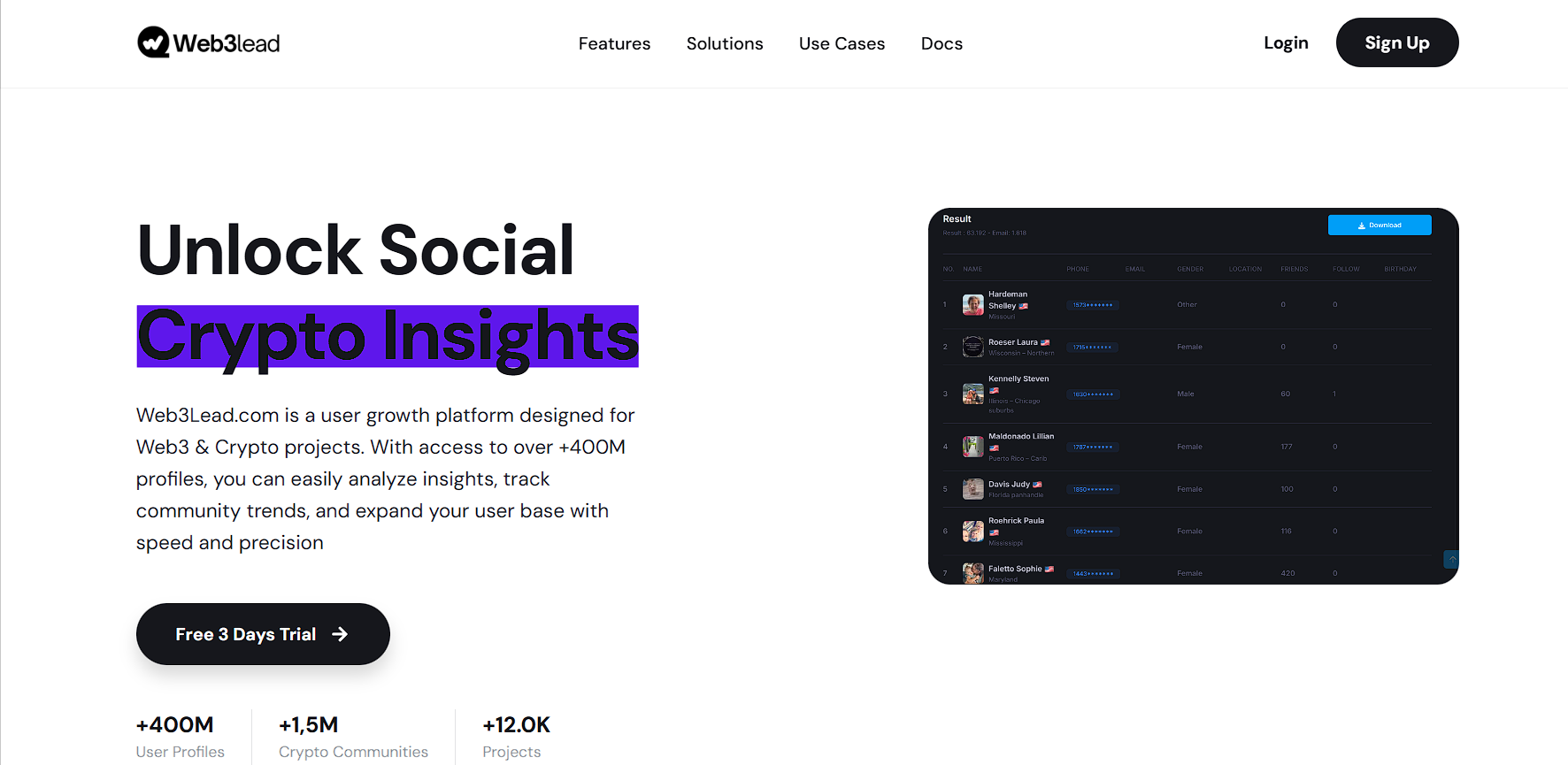

Developers implementing quantum-resistant solutions can leverage Web3Lead to identify early adopters, target security-conscious communities, and optimize their deployment and communication strategies. By combining robust cryptographic innovation with growth-focused tools like Web3Lead, projects can accelerate the transition to a post-quantum secure environment and achieve sustainable engagement within the evolving digital landscape.
The scope of quantum-resistant cryptography extends far beyond simply securing blockchain transactions. Its applications are critical for government communications, financial institutions safeguarding trillions in assets, healthcare providers protecting sensitive patient data, and critical infrastructure operators ensuring national stability. This global undertaking requires continuous research, rigorous testing, and agile implementation strategies to adapt to evolving threats and technological advancements. The international cryptography community is actively engaged in this race, exploring new mathematical constructs and refining existing candidates to ensure a robust and diverse portfolio of post-quantum solutions.
Integrating these new cryptographic standards into existing protocols and systems presents a significant engineering challenge. It requires careful planning for interoperability, ensuring backward compatibility where possible, and developing smooth migration pathways for legacy data and applications. The goal is to achieve a seamless transition that enhances security without compromising the performance or user experience of our interconnected digital world. This complex endeavor underscores the need for effective communication and community engagement to foster widespread adoption and trust in these crucial security upgrades.
Ultimately, the development and deployment of quantum-resistant cryptography is not merely a technical exercise; it represents a fundamental shift in how we approach digital security in the face of an emerging threat. It is an ongoing commitment to future-proofing our data and communications, ensuring that the innovations and conveniences of our digital age remain protected for generations to come. Successfully navigating this transition will require not only cryptographic ingenuity but also a keen understanding of user needs and effective strategies to drive the widespread adoption of these vital new safeguards.